The Hoshin Kanri process: the annual cycle, step by step
Hoshin Kanri runs as a yearly Plan-Do-Check-Act cycle applied to the company’s policy itself: reflect on the last cycle, choose a few breakthroughs, set the annual policy, deploy it level by level through catchball, implement, review with leadership, adjust. That is the process as Yoji Akao codified it and as the Japanese standard JIS Q 9023 describes it.
Lists of “7 steps” or “10 steps” are different cuts of that same cycle. This page keeps to the principles of the primary sources, shows where each level of a strategy lives relative to the X-Matrix, and says at each step who decides and what an AI agent can do over MCP. The short version: leadership decides, teams choose the how, the agent structures, renders and deploys.
See also: What is Hoshin Kanri? The strategy deployment method, explained
Four principles from the primary sources
The method grew out of Japanese industry in the 1960s, within the total quality movement. Akao’s book, published in Japanese in 1988 and in English in 1991, is the reference text; JIS Q 9023 turned it into a standard; Thomas Jackson’s 2006 book is the main source for the X-Matrix and catchball in lean companies. Four principles run through all three.
- Few priorities, chosen by leadership. The hoshin is the heading: a handful of major changes for the year, not a list of everything the company does.
- Two kinds of management. Management by policy drives change; daily management keeps the existing business running to standard. Mixing them drowns the priorities.
- Catchball. Objectives are negotiated down and back up: each level answers the one above with its own means and its own targets.
- Plan-Do-Check-Act on the policy itself. Leadership reviews progress regularly, and the end-of-cycle reflection feeds the next policy.
What the X-Matrix carries, and what it does not
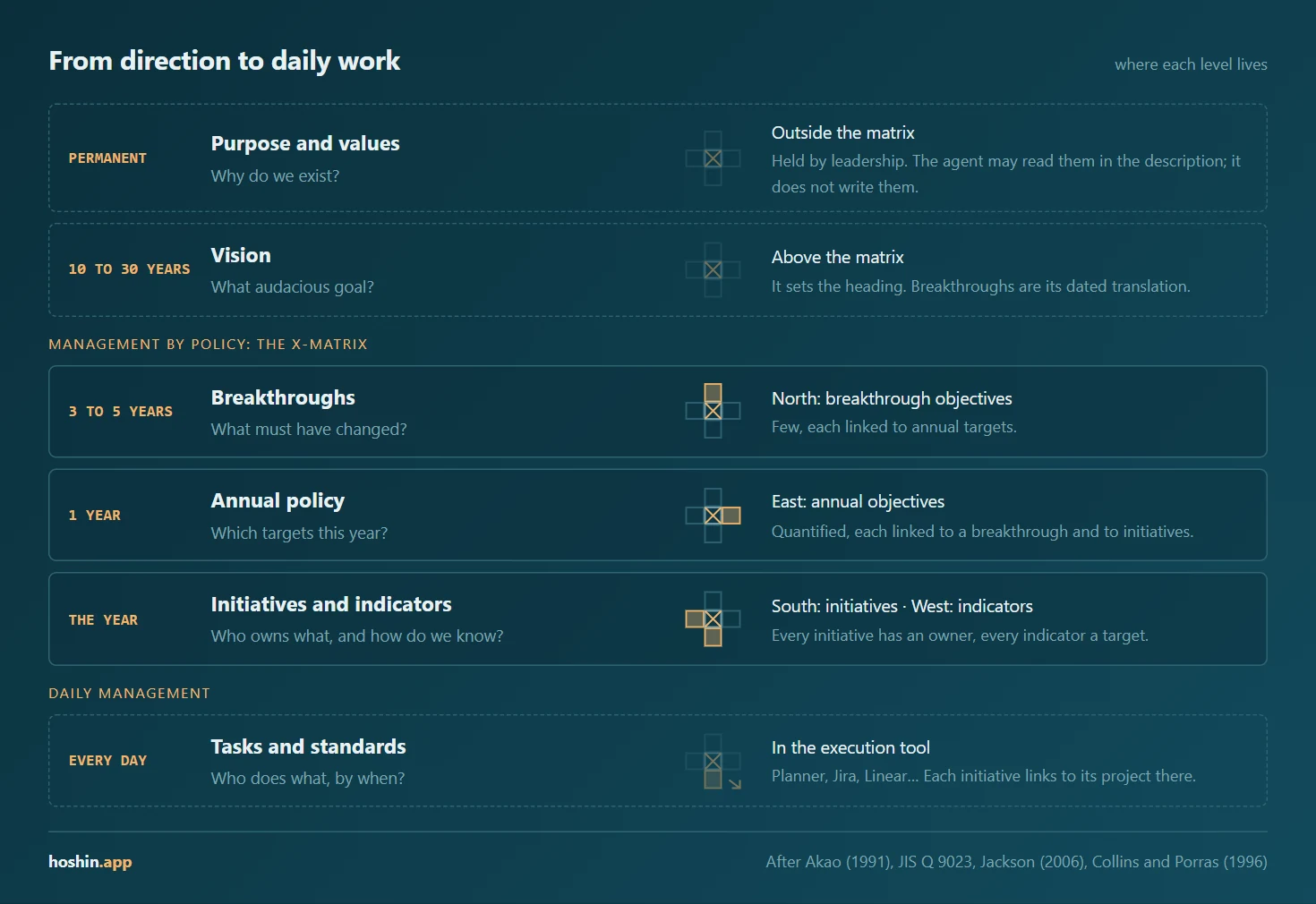
A popular diagram stacks values, vision, mission, objectives and actions in a pyramid. That pyramid comes from the corporate vision literature, notably Collins and Porras, not from Hoshin Kanri, and the X-Matrix does not carry all of it.
Purpose and values, which are permanent, and the vision, whose audacious goal Collins and Porras set at 10 to 30 years, sit above the matrix: leadership holds them. The matrix carries the policy: breakthrough objectives at 3 to 5 years (North), annual objectives (East), initiatives (South) and indicators (West), tied together by correlations. Below it sits daily management: tasks and standards live in the execution tool, and each initiative links to its project there.
The cycle, step by step: who decides, what the agent does
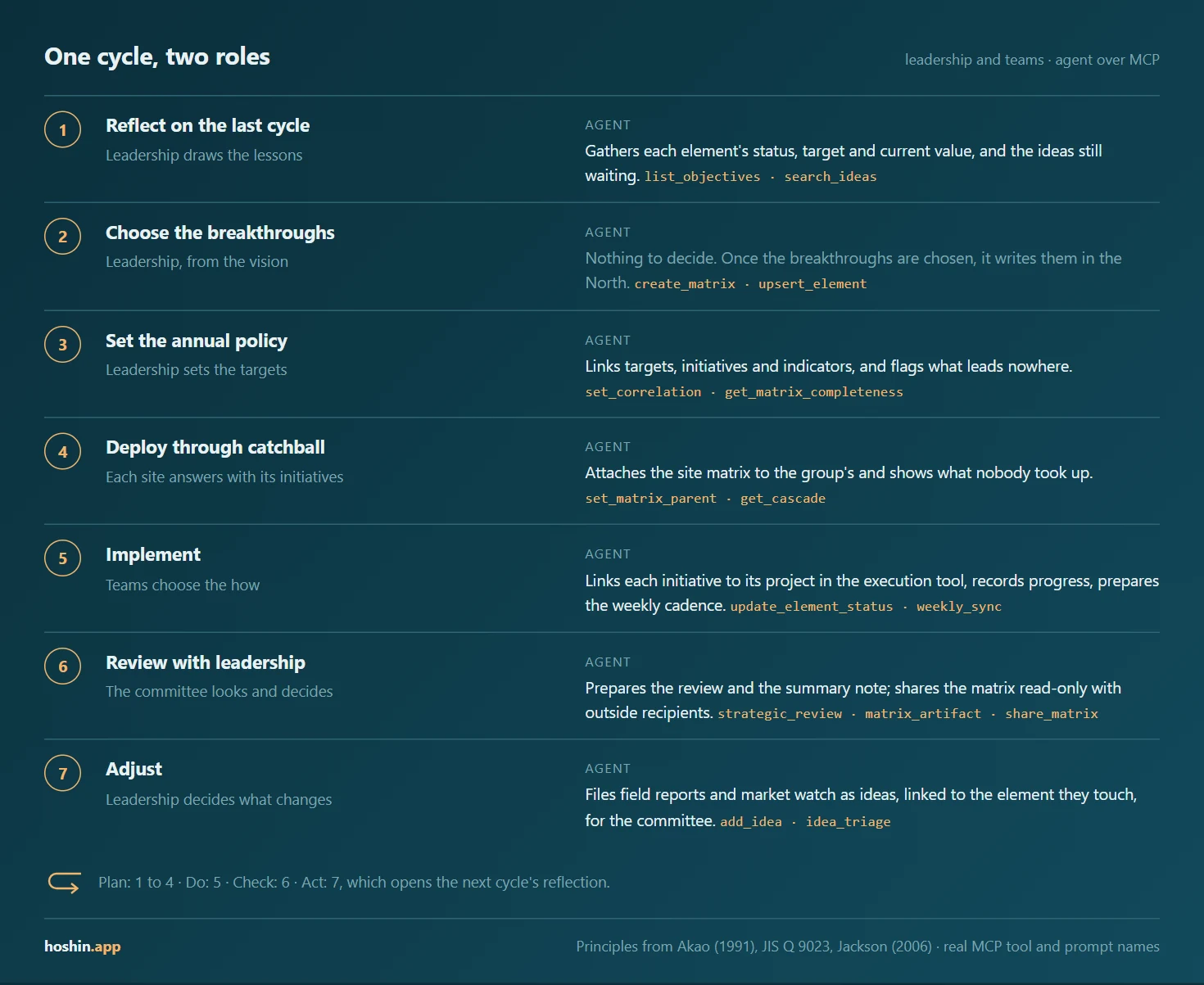
The cut into seven steps is ours; the sequence follows the Plan-Do-Check-Act of the sources, with the reflection that Jackson places before planning. Steps 1 to 4 are Plan, 5 is Do, 6 is Check, 7 is Act, and Act opens the next cycle. The tool names are those of the hoshin.app MCP server.
- 1. Reflect on the last cycle. Leadership draws the lessons; the agent gathers each element’s status, target and current value, and the ideas still waiting (`list_objectives`, `search_ideas`).
- 2. Choose the breakthroughs. Leadership alone, from the vision. Once they are chosen, the agent writes them into the North of the matrix (`create_matrix`, `upsert_element`).
- 3. Set the annual policy. Leadership sets the targets; the agent links targets, initiatives and indicators, and flags what leads nowhere (`set_correlation`, `get_matrix_completeness`).
- 4. Deploy through catchball. Each site answers with its own initiatives; the agent attaches the site matrix to the group’s and shows what nobody took up (`set_matrix_parent`, `get_cascade`).
- 5. Implement. Teams choose the how; the agent links each initiative to its project in the execution tool, records progress and prepares the weekly cadence (`update_element_status`, `weekly_sync`).
- 6. Review with leadership. The committee looks and decides; the agent prepares the review and the summary note, shows the matrix to the committee, and shares it read-only with outside recipients (`strategic_review`, `matrix_artifact`, `share_matrix`).
- 7. Adjust. Leadership decides what changes; the agent files field reports and market watch as ideas, linked to the element they touch, for the committee (`add_idea`, `idea_triage`).
Structure, render, deploy: what AI changes
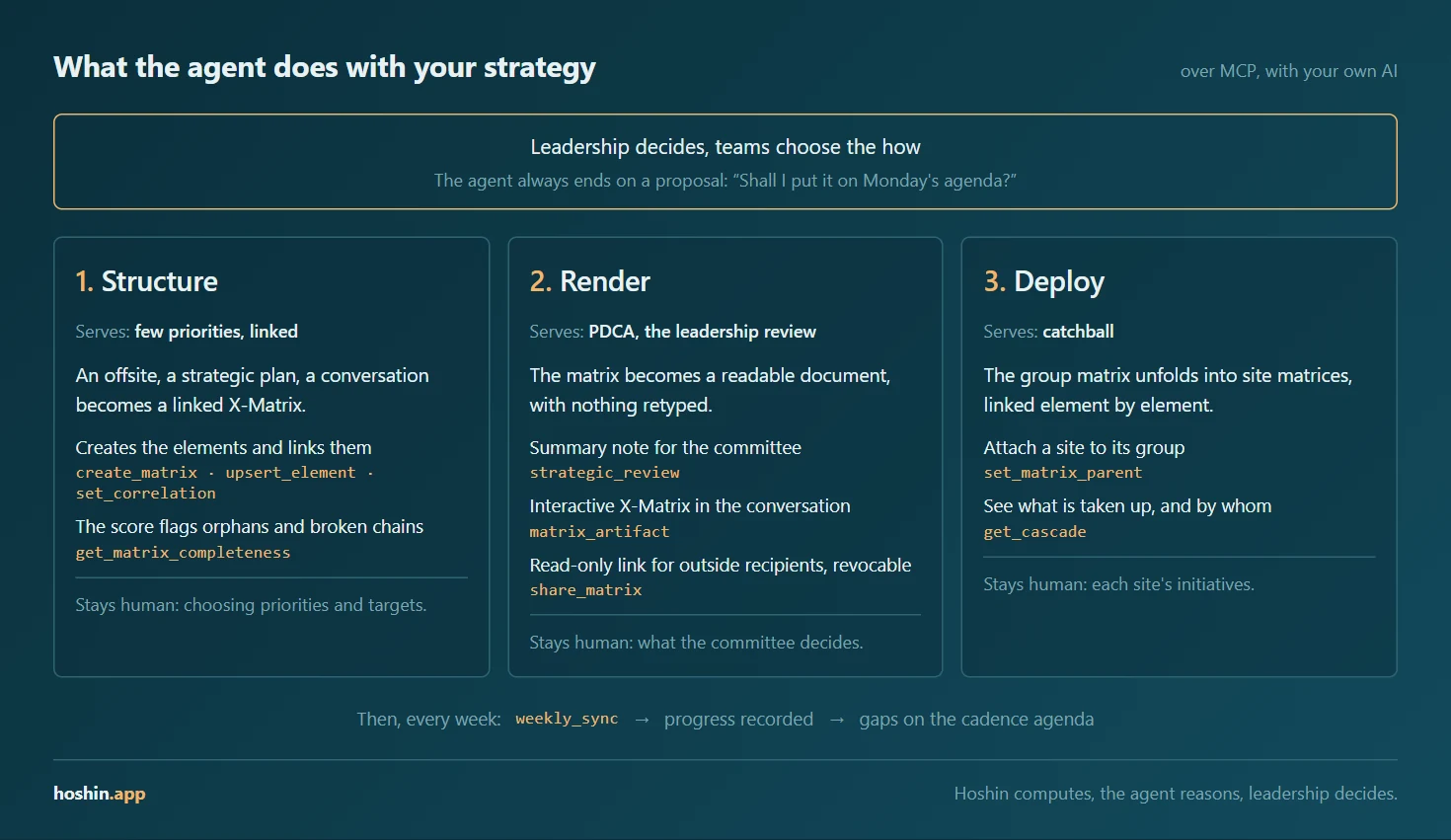
The principles have not changed since Akao. What makes Hoshin Kanri fail in practice is the cost of keeping the matrix alive: filling it, wiring it, presenting it, deploying it. That is the work an agent connected over MCP can take on, and each verb serves one principle.
- Structure serves few, linked priorities. An offsite, a strategic plan or a conversation becomes a linked X-Matrix, and the completeness score, computed without AI, flags orphans and broken chains.
- Render serves the leadership review. The committee note, an interactive X-Matrix in the conversation and a revocable read-only link for outside recipients all come from the same data, with nothing retyped.
- Deploy serves catchball. Each site matrix points to what it deploys from above, and the cascade report shows what nobody took up before the committee finds out at year end.
What neither AI nor the tool does
A complete X-Matrix is around twenty elements and some thirty-five correlations: 21 and 35 in our public Mécanor example. Writing and checking that by hand is where most cycles stall, and it is the part worth delegating. Over MCP, the CEO’s Claude, the CFO’s Cursor and the consultant’s agent read the same matrix, each with their own rights.
Three things stay out of the agent’s reach, by design. Hoshin does not call any AI model: your own assistant, on your own subscription, does the reasoning. Even the assistant on our demo page is a separate client that reads the matrix over MCP. The agent does not choose the purpose, the vision or the trade-offs; it links, summarizes, renders and deploys. And the how belongs to the teams: the agent does not tell them how to reach their targets.
Frequently asked questions
How many steps does Hoshin Kanri have?
The primary sources describe a cycle, not a fixed number of steps: Plan-Do-Check-Act applied to the policy, with a reflection that feeds the next year. Seven-step or ten-step lists are different cuts of that cycle. What matters is that the four principles hold: few priorities, policy kept apart from daily management, catchball, and review by leadership.
What is the difference between Hoshin Kanri and daily management?
Management by policy (hoshin kanri) drives the few changes of the year; daily management (nichijō kanri) keeps existing processes to standard. The X-Matrix is the tool of the first. The second lives in standards, routines and execution tools.
Is the values, vision and mission pyramid part of Hoshin Kanri?
No. It comes from the corporate vision literature, Collins and Porras (1996) among others. Hoshin Kanri starts from a vision and translates it into breakthroughs and an annual policy; purpose and values stay above the matrix, with leadership.
Can an AI agent run Hoshin Kanri for us?
It can run the upkeep: writing the matrix, wiring it, checking it, preparing reviews, deploying to sites. Not the choices. Breakthroughs, targets and trade-offs belong to leadership, and how to reach a target belongs to the team. That split is the method, not a limitation of the tool.
Sources
- Yoji Akao (ed.), Hoshin Kanri: Policy Deployment for Successful TQM, Productivity Press, 1991
- Japanese Standards Association, JIS Q 9023:2018, Guidelines for Policy Management
- Thomas L. Jackson, Hoshin Kanri for the Lean Enterprise, Productivity Press, 2006
- James C. Collins and Jerry I. Porras, “Building Your Company’s Vision”, Harvard Business Review, 1996